Source:http://andrew-gumperz.blogspot.com.ar/
P. Hal Sims was a top-selling bridge author of the 1930s and a formidable player. His forte was card reading. The egotistical Sims bragged about his card-reading abilities so often that his friends once played a practical joke on him. They set up a hand where he would surely bid a grand slam and making the slam would depend on locating the Q.
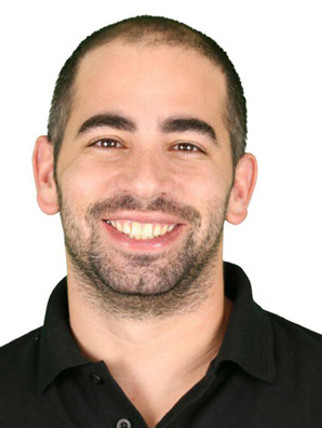
Andrew Gumperz
They arranged for two unsuspecting LOLs to defend and to confound Sims they modified the deck slightly—each LOL held a Q. Sims duly bid the grand slam, and, after reaching the decision point during the play, entered a deep tank. The large man loomed over the table, glowering intensely at one opponent. Then he gave the other LOL the same performance. After a moment he shrank back in his chair, seemingly confused. Finally he spoke up: “There is something wrong here—you both have the Q!”
Though not all of us can be Hal Sims, table feel—the ability to place cards by reading behavior—is real and anyone can learn it. It is a combination of observation and bridge logic. Learning table feel takes patience, but the pay-off is a big one. Table feel is fun!
Table feel has three components:
A receptive mind
Identifying tells
Interpreting tells
A Receptive Mind
Reading people depends on your own emotional state. Strong emotions inside of you, particularly negative ones, short-circuit people-reading abilities. When you are angry, sad, anxious, or happy, you are focused on your own feelings. You may be so focused that you don’t even notice reactions from people around you. And even if you do notice the reactions, you will be tempted to assign meanings to them which reflect your own emotional state rather than the emotions of the other person.
If you are feeling insecure, you may interpret a curl of the opponent’s lip as supercilious judgment towards you when in reality, it was annoyance at his own hasty play five seconds before. Even small amounts of fear and anxiety will pollute your card-reading skills. So the first skill you must cultivate is happy, inquisitive detachment.
Some players develop card-reading skills but veer off into the wrong frame of mind. These people spot hesitations but they assume that every hesitator is trying to cheat them. Needless to say, this is untrue, but we probably all know someone who takes this attitude. The anger that the idea of cheating generates inside them seriously undermines their ability to interpret the hesitations correctly.
Suppose the auction begins 1P-2-? and RHO tanks for a few seconds before passing to you. You should be thinking, “Gee, I wonder why he did that.” If you shrug and say to yourself, “Who knows?” and mentally move on, you just missed a chance to develop your skills.
Note the pause and then finish bidding and playing. When the hand is over, find out what RHO actually held and try to identify why RHO was thinking. When you know that, you will have learned something about that player. When you have seen this situation three or four times, you can start to generalize about all players. Build a database on the behaviors and bidding habits of your opponents.
Resist the temptation to guess what your opponent holds prematurely. Before you have built your database, your guesses will be inaccurate. It is easy to feel discouraged and give up trying to read people after bad guesses. Instead, treat the situation as a scientist would.
You have observed a hesitation during the auction but have no idea what it means. Research the cause of that hesitation. Once you have a reasonable sample of hesitations, form a hypothesis. For example, “When we are in a strong auction and a weak opponent hesitates unduly after a natural bid, he often has length in the bid suit.” Finally test the hypothesis by seeing whether it works in future at the table.
Identifying Tells
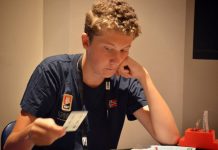
Players exhibit a wide range of emotions through facial expressions, body language, tone of voice, and tempo. Poker players call these signs “tells.” Obvious examples are long hesitations or loud doubles, but the more useful tells are more subtle. if you have a knack for seeming to “know” without being told how people feel, you will have no trouble spotting and eventually reading tells. And if you don’t, don’t worry. It is a learned skill that improves with practice. Observing tells is usually no harder than making an effort. Look for things like:
Signs of interest in the hand or play
Hesitations, especially at unexpected times
Signs of tension in how a player plays a card
Signs of surprise
Signs of relaxation
Detaching a card prematurely
Nervous table talk
Speedy or eager bids/plays
During the play, it is easier to pick up a tell when an opponent is forced to make a decision early. For example, LHO may experience anxiety when you lead a small card towards honors in dummy before he has had time to work out your shape. He may break tempo, or reveal anxiety in some other way. In a recent club game, I led a Jack towards dummy’s ATx in an unbid suit. My LHO, an experienced player, played low in tempo but his eyes flicked from my card to his hand three times in rapid succession. I decided that holding only small cards, he would not need to check his hand three times to confirm his play so I finessed (successfully).
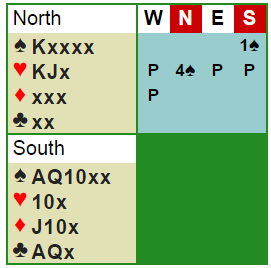
A great time to look for tells is after the opening lead. Consider the position above as East. Unfortunately, the auction has been uninformative and your lead choices are poor. Leading from an ace is unattractive, leading trumps is dangerous and there is no clear choice of minor suits. Either minor could be right, but if wrong, might blow the contract. Regardless of what they lead, almost all players will feel anxiety as they make their choice. Anxiety will often be visible on their faces as the dummy hits the table or may be revealed by their eagerness to see dummy. As declarer, that tell might help you workout where the highcards are.
Interpreting Tells
Interpreting tells depends on the ability to:
generalize from past experience
combine information from tells with information from other sources
People’s behavior is surprisingly consistent. Take the situation of a 2-way finesse for the queen. I have it on good authority from one America’s great players that in general, the person who won’t meet your gaze is the one who holds the queen. There are exceptions–aggressive males may meet your gaze because they perceive it as challenge. But most of the time this rule works well.
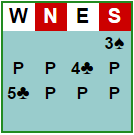
Here is another example. Most players when presented with a close decision whether or not to double the final contract will take some time before making the final pass. That is not a particularly deep observation, but once in a while it can save your skin. Consider this hand I played years ago in a regional KO against a pair of American experts:
South stared at his cards intently several seconds before his final pass. My partner had made an unfortunate decision to raise clubs on his singleton rather than introduce his broken diamond suit so I was playing a 6-1 club fit instead of a 6-4 diamond fit. Since I had to lose the A, I could afford only one club loser with this position:
10 front A Q 8 x x x
The normal play is to finesse the Q, hoping for 3-3 clubs with the king onside. However, I remembered my LHO’s slow pass. Surely the expert on my left was not thinking of sacrificing in 5red-against-white. No, the only explanation was he had considered doubling 5. This could only mean he held 2+ defensive tricks. Since I had all the top red cards, that pointed to him holding the guarded K in addition to his A. Yet he had rejected the double. With trumps like KJxx he certainly would have doubled, so perhaps I had a chance. Here was the full trump position:
10
K9x
J7x
AQ8xxx
I led the 10 and when RHO did not cover I ran it. When LHO went into a tank before winning the K, I knew I had made the right decision. RHO could have beaten me by covering the 10, but it was not obvious to do so.
Correctly interpreting tells often depends on knowing the experience levels of the opposing players. When I lead towards a KJ combination, weak players will frequently fumble or hesitate from a holding like xx, xxx or xxxx. Experts never do. It is tempting to think that someone who fumbles must have the ace, but having learned this tendency I now look deeper. If a weak player fumbles for their spot but seems relaxed, chances are good they do not have the ace. If a stronger player fumbles, chances are I caught them napping and they do in fact have the ace.
I once played a touch-and-go 3NT against an American expert. The contract depended on the location of the A. When I led a small spade towards dummy’s K, LHO ducked smoothly but there was something odd about his manner. He displayed no signs of discomfort, but he did not seem relaxed either. He was aware I was watching him and he stared at one spot in the center of the table, like a person working to maintain a blank mask. His lack of relaxation was the key to determining that he held the ace.
As declarer, there is plenty of information to use. Tells can often be combined with revealing events from the play. Sometimes even the lack of a tell can point you in the right direction. Consider this hand:
The opening lead is a low club which goes to RHO’s K and your A.
You cash the A and K, LHO following small and J and RHO following small then pitching a heart on the K.
You cash A and then ruff a club in dummy, all following.
You exit with a diamond from dummy. RHO wins the first diamond with the K, then continues with a low diamond to LHO’s Q.
LHO cashes A, all following, and now shifts to a low heart.
What do you play? If both heart honors are with either player your decision is irrelevant, so assume the honors are split. Before you play, let’s reconstruct LHO’s hand. He has shown up with something like one of these hands:
Hand 1: Jx Qxx(x) AQx(x) Jxxx
Hand 2: Jx Axx(x) AQx(x) Jxxx
The second hand is a marginal takeout double of 1. So think back to LHO’s first pass. Was it effortless, or did he have something to think about? If he did look thoughtful I will wager he holds the second hand.
Conclusion
There is an old joke. A new singer asks an opera diva, “Excuse me, but how do I get to Carnegie Hall?” She replies, “Practice, practice, practice.”
It takes time to learn to detect tells. It takes more time to learn to interpret them. Be patient and practice the skill. Avoid a rush to judgment. Just because a player gives off a tell does not mean you are ready to interpret it. A tell is caused by a feeling. Interpreting a tell is working backward from the feeling to the cards that person must hold to generate the feeling by an inferential process and it is error prone. However, when you get good at it, there are few feelings more exciting and more powerful than guessing hands correctly based on table feel.









 Q.
Q.

 P-2
P-2 -? and RHO tanks for a few seconds before passing to you. You should be thinking, “Gee, I wonder why he did that.” If you shrug and say to yourself, “Who knows?” and mentally move on, you just missed a chance to develop your skills.
Note the pause and then finish bidding and playing. When the hand is over, find out what RHO actually held and try to identify why RHO was thinking. When you know that, you will have learned something about that player. When you have seen this situation three or four times, you can start to generalize about all players. Build a database on the behaviors and bidding habits of your opponents.
Resist the temptation to guess what your opponent holds prematurely. Before you have built your database, your guesses will be inaccurate. It is easy to feel discouraged and give up trying to read people after bad guesses. Instead, treat the situation as a scientist would.
You have observed a hesitation during the auction but have no idea what it means. Research the cause of that hesitation. Once you have a reasonable sample of hesitations, form a hypothesis. For example, “When we are in a strong auction and a weak opponent hesitates unduly after a natural bid, he often has length in the bid suit.” Finally test the hypothesis by seeing whether it works in future at the table.
Identifying Tells
Players exhibit a wide range of emotions through facial expressions, body language, tone of voice, and tempo. Poker players call these signs “tells.” Obvious examples are long hesitations or loud doubles, but the more useful tells are more subtle. if you have a knack for seeming to “know” without being told how people feel, you will have no trouble spotting and eventually reading tells. And if you don’t, don’t worry. It is a learned skill that improves with practice. Observing tells is usually no harder than making an effort. Look for things like:
-? and RHO tanks for a few seconds before passing to you. You should be thinking, “Gee, I wonder why he did that.” If you shrug and say to yourself, “Who knows?” and mentally move on, you just missed a chance to develop your skills.
Note the pause and then finish bidding and playing. When the hand is over, find out what RHO actually held and try to identify why RHO was thinking. When you know that, you will have learned something about that player. When you have seen this situation three or four times, you can start to generalize about all players. Build a database on the behaviors and bidding habits of your opponents.
Resist the temptation to guess what your opponent holds prematurely. Before you have built your database, your guesses will be inaccurate. It is easy to feel discouraged and give up trying to read people after bad guesses. Instead, treat the situation as a scientist would.
You have observed a hesitation during the auction but have no idea what it means. Research the cause of that hesitation. Once you have a reasonable sample of hesitations, form a hypothesis. For example, “When we are in a strong auction and a weak opponent hesitates unduly after a natural bid, he often has length in the bid suit.” Finally test the hypothesis by seeing whether it works in future at the table.
Identifying Tells
Players exhibit a wide range of emotions through facial expressions, body language, tone of voice, and tempo. Poker players call these signs “tells.” Obvious examples are long hesitations or loud doubles, but the more useful tells are more subtle. if you have a knack for seeming to “know” without being told how people feel, you will have no trouble spotting and eventually reading tells. And if you don’t, don’t worry. It is a learned skill that improves with practice. Observing tells is usually no harder than making an effort. Look for things like:
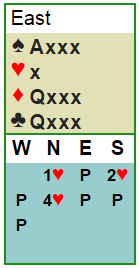 A great time to look for tells is after the opening lead. Consider the position above as East. Unfortunately, the auction has been uninformative and your lead choices are poor. Leading from an ace is unattractive, leading trumps is dangerous and there is no clear choice of minor suits. Either minor could be right, but if wrong, might blow the contract. Regardless of what they lead, almost all players will feel anxiety as they make their choice. Anxiety will often be visible on their faces as the dummy hits the table or may be revealed by their eagerness to see dummy. As declarer, that tell might help you workout where the highcards are.
Interpreting Tells
Interpreting tells depends on the ability to:
A great time to look for tells is after the opening lead. Consider the position above as East. Unfortunately, the auction has been uninformative and your lead choices are poor. Leading from an ace is unattractive, leading trumps is dangerous and there is no clear choice of minor suits. Either minor could be right, but if wrong, might blow the contract. Regardless of what they lead, almost all players will feel anxiety as they make their choice. Anxiety will often be visible on their faces as the dummy hits the table or may be revealed by their eagerness to see dummy. As declarer, that tell might help you workout where the highcards are.
Interpreting Tells
Interpreting tells depends on the ability to:
 Qxx(x)